Abrahamic Hospitality: What Philoxenia Means and How to Live It Today
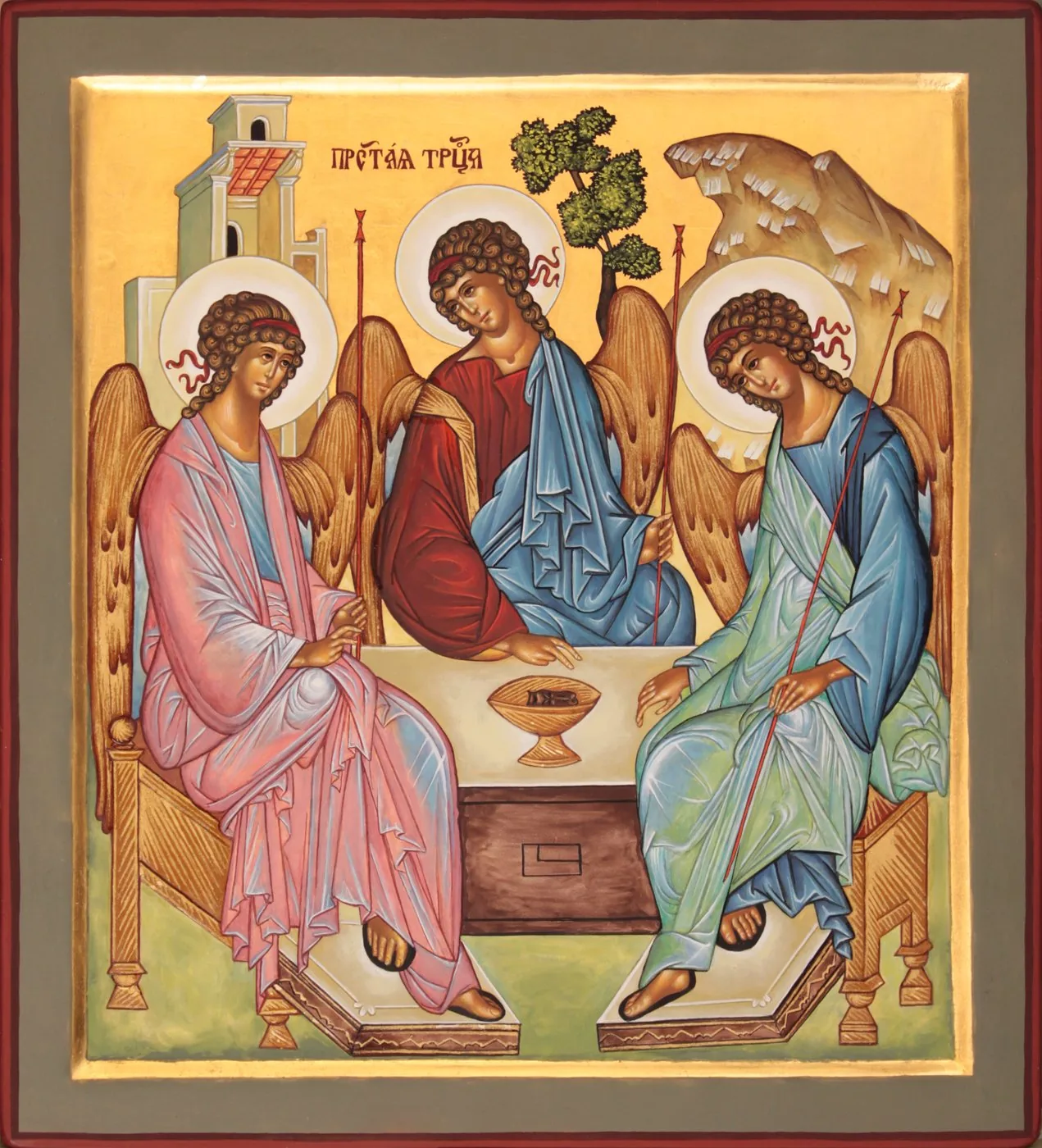
Abrahamic hospitality is the oldest Christian way of welcoming: opening the door to the stranger as if God himself were knocking. It takes its name from Abraham, who by the oaks of Mamre welcomed three strangers and, without knowing it, welcomed the Lord. The Eastern tradition calls this episode Philoxenia, "love of the stranger", and has made it one of the best-loved icons in all of Christendom.
The story of Genesis 18
Abraham sits at the entrance of his tent in the heat of the day. He looks up and sees three men standing before him. He does not wait for them to ask: he runs to meet them, bows to the ground and begs them not to pass him by. He has a little water brought to wash their feet, asks Sarah to knead bread from fine flour, chooses a tender, good calf and has it prepared. Then he stands beside them under the tree while they eat.
The text does not say that Abraham asked who they were, where they came from or what they could give in return. He serves them. Only at the end does the story reveal that the Lord was present in those three guests, announcing the birth of Isaac.
What Philoxenia means
The Greek word philoxenía joins phílos, "friend, one who loves", and xénos, "stranger, guest". It is the very word used in the Letter to the Hebrews: "Do not neglect to show hospitality to strangers, for thereby some have entertained angels unawares" (Heb 13:2). For the first Christians hospitality was not an optional courtesy but a sign of recognition: wherever there was a community, the pilgrim found a table and a prayer.
Rublev's icon of the Trinity
In Byzantine and Russian iconography the scene at Mamre is called precisely the Philoxenia of Abraham. In the early fifteenth century the monk Andrei Rublev turned it into the famous icon of the Trinity, kept for almost a century in the Tretyakov Gallery in Moscow and since 2024 in the Trinity Lavra of Saint Sergius at Sergiev Posad (as of October 2026): Abraham and Sarah disappear, and the three angels remain seated around a table, with an empty place in front, like an invitation to the viewer. It is perhaps the most beautiful image of what Christian hospitality is: a place left open at the table.
"I was a stranger and you welcomed me"
In the Gospel of Matthew (25:35) Christ identifies himself with the stranger: whoever welcomes the stranger welcomes Him. This is why monasteries in both East and West have always kept a guesthouse and a table for pilgrims. In the Rule of Saint Benedict guests are to be received "as Christ"; in Orthodox monasteries pilgrims are welcomed with a glass of water, a sweet and a prayer.
How I live it in my home
In my home near Taormina I try to live the same spirit, in a simple way. I do not offer accommodation or a service: I invite people to share a day. We pray together, prepare the meal and eat it at the same table, indoors or outdoors, under a tree or in a meadow, like Abraham by the oaks of Mamre. We walk in the countryside, talk about the saints, take time to be together. In the evening everyone returns to their own home.
Hospitality has no price and does not depend on any offering: whoever comes is welcomed for who they are. Everyone contributes as they can: anyone who cannot leave anything is welcomed like everyone else, and takes part by giving a little of their time. Everything is described on the page Christian spiritual days in Sicily.
Hospitality is for everyone: an invitation
You do not need a big house or a perfect life to welcome others. A table, an open door and the desire to share what you have are enough. If many Christian families opened their doors even for just a few days a year, no pilgrim would be left alone. If these words touch you, write to me: I will be happy to tell you about my experience.
How to take part
The days take place near Taormina, in Sicily. The places to visit are agreed together each time. There is no overnight stay: we share one day, and in the evening everyone returns to their own home. Hospitality has no price and does not depend on any offering: whoever comes is welcomed for who they are. Everyone contributes as they can: anyone who cannot leave anything is welcomed like everyone else, and takes part by giving a little of their time.
The days are reserved for Catholic and Orthodox Christians, because they are lived in shared prayer. To ask for a date, simply write to me on WhatsApp. The spirit of the days is told in the manifesto of hospitality.
If you would like to know what makes this mission possible, read The circle of love.
Explore the other pages
The days: Christian spiritual days in Sicily · Spiritual search and finding yourself · Day retreat, silent retreat and pilgrimage: the international names
Spiritual travel in Sicily: Spiritual tourism in Sicily: the guide · Pilgrimage walking routes in Sicily · Holy Week and Easter in Sicily · Religious festivals in Sicily: the calendar · Orthodox pilgrimage in Sicily · Spiritual Nordic walking and ski walking in Sicily
Nature and places: Spiritual Taormina · Spiritual walks in nature · Christian meditation in nature in Sicily · Places to meditate near Taormina and Messina · Places to meditate in Sicily
Prayer: Christian asceticism: the spiritual struggle · The prayer of the heart or Jesus Prayer · Hesychasm: the prayer of stillness · The Philokalia: the Neptic Fathers
The saints of Sicily: Byzantine Sicily and the Italo-Greek saints · Saint Hilarion the Great in Sicily · Saint Methodios of Syracuse · Saint Joseph the Hymnographer · Saint Elias the Younger of Enna · Saint Agatha of Catania · Saint Lucy of Syracuse · Saint Pancras of Taormina
Sources
- Genesis 18:1-15 (Bible Gateway, RSV)
- Hebrews 13:2 (Bible Gateway, RSV)
- Matthew 25:31-46 (Bible Gateway, RSV)
- Wikipedia – Trinity (Andrei Rublev), history and location
What this story teaches
A place left free at the table is the simplest form of prayer: it tells God that we are waiting for Him.
Frequently Asked Questions
What is Abrahamic hospitality?
It is welcoming the stranger on the model of Abraham by the oaks of Mamre (Genesis 18): going to meet them, serving them and offering the best, asking nothing in return.
What does the word Philoxenia mean?
It comes from the Greek philoxenía, from phílos (loving) and xénos (stranger, guest): it means love of the stranger.
Where is the story of Abraham and the three guests?
In the Book of Genesis, chapter 18, verses 1-15.
Who were Abraham's three guests?
The text says the Lord was present in them. Many Fathers of the Church read it as a foreshadowing of the Trinity; others saw the Lord accompanied by two angels.
What is the link with Rublev's Trinity icon?
Rublev painted the scene at Mamre leaving out Abraham and Sarah and keeping the three angels around the table: in this way the Philoxenia became the icon of the Trinity. Since 2024 it has been kept in the Trinity Lavra of Saint Sergius at Sergiev Posad.
What does the Bible say about hospitality?
Among the best-known passages: Genesis 18, Hebrews 13:2 ("some have entertained angels unawares") and Matthew 25:35 ("I was a stranger and you welcomed me").
Does this hospitality include staying overnight?
In my experience, no: we share one day, and in the evening everyone returns home. I do not offer accommodation or a service.
Why is hospitality important for Christians?
Because Christ identifies himself with the stranger: to welcome another person is to welcome Him. That is why monasteries and communities have always kept a table for pilgrims.
How are guests welcomed in Orthodox monasteries?
Usually with a simple gesture: a glass of water, a sweet, sometimes a coffee, and a prayer. Then the guest shares in the life of the community.
What does Saint Benedict say about guests?
In his Rule he asks that all guests be received as Christ, because He himself will say: "I was a stranger and you welcomed me".
Can I welcome others like Abraham too?
Yes. You do not need a big house: a table, an open door and the desire to share are enough. Even a few days a year can make a difference to someone who is alone.
How can I share a day of hospitality with you?
By writing to me on WhatsApp at +39 370 379 45 76. The days take place near Taormina, are reserved for Catholic and Orthodox Christians, entirely free.