Hand-painted gold sacred icons: the wedding gift that becomes an heirloom
I don't like advertising on these pages, but this is an exception worth your attention. Anyone who knows hand-painted sacred icons knows they are not just any religious paintings: they are prayers made of wood, gesso, gold and colour, born of a tradition more than a thousand years old. This page is for those who can tell a true icon from a reproduction, and for those who want to learn how before choosing a gift that will last for generations.
A story: the parish group and the Wedding at Cana
Think of a group of young people who have met every week at their parish for almost ten years. They have done summer camps, pilgrimages and late nights preparing the patron saint's feast together. Now two of them are getting married, and the others wonder what to give them.
Someone suggests the usual envelope. Someone else, a kitchen appliance. Then a young woman in the group who studied art history says: "Let's give them something that lasts. An icon. But a real one, hand-painted, with gold." The others look at each other. Nobody had thought of it. None of them could afford it alone, but together, twenty of them, they can.
They visit an iconography studio between Messina and Taormina. For the first time they see up close how an icon is born: wooden panels prepared in layers, gold settling on the surface, natural pigments ground by hand, faces coming to life one veil of colour at a time. They realise they are not buying an object. They are commissioning a work of art.
They choose the Wedding at Cana: Jesus's first miracle, which took place at a wedding feast, when water became wine so that the couple's joy would not run out. There could be no more fitting subject.
On the wedding day, at the reception, they give the icon to the couple. The bride unwraps it and falls silent. The gold catches the candlelight on the tables. The groom runs a finger along the edge of the panel, without touching the painting, as one does with precious things.
Years later, the icon hangs in the most beautiful corner of their home. Their children have grown up looking at it. One day the youngest asks: "Why is there gold behind everyone?" And his mother explains that the gold is not a background: it is the light of God.
What a sacred icon really is
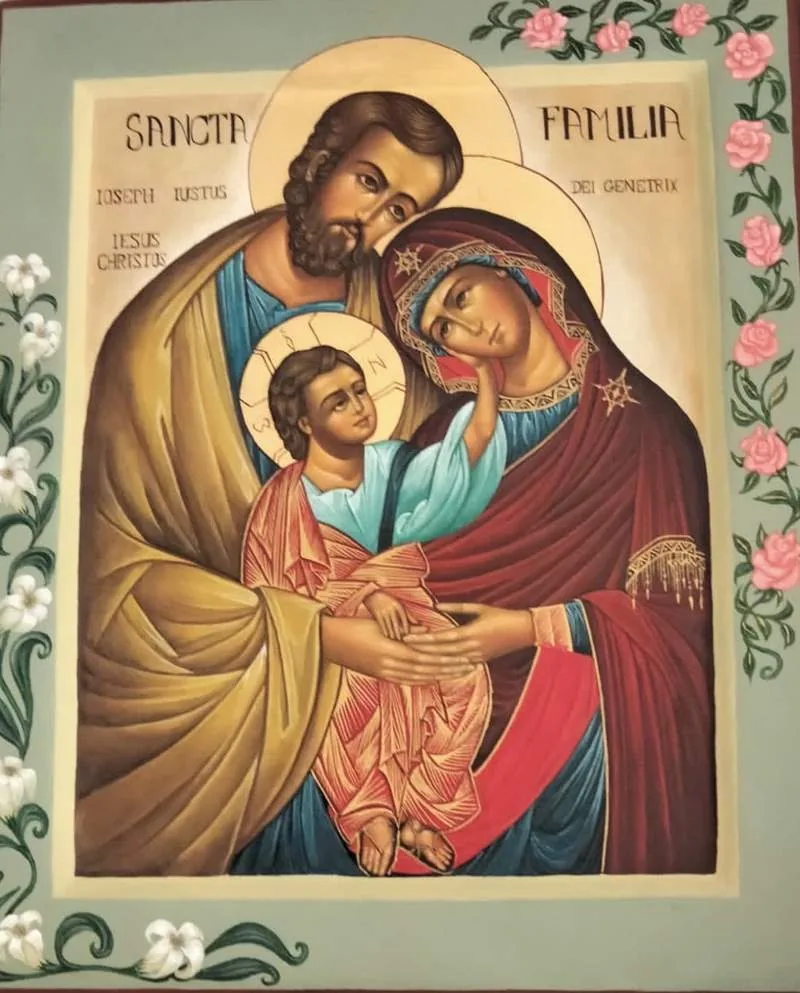
In the Byzantine tradition an icon is not painted: it is written. In Greek the same word means both to write and to paint, and the icon is considered a Scripture made of images. It does not try to imitate reality, but to open a window onto the eternal.
- Gold does not represent a sky or a background: it is the divine, uncreated light in which the saints live.
- Reverse perspective makes lines converge towards the viewer, not the horizon: it is the icon that comes to meet us.
- Faces are not psychological portraits: they are transfigured, peaceful faces, with large eyes that look beyond.
- Colours carry meaning: red for divinity, blue for humanity, white for the resurrection.
In 787 the Second Council of Nicaea affirmed the veneration of icons: those who venerate them do not honour wood and paint, but the person depicted. That is why a true icon is both a work of art and an object of prayer.
How a handmade Byzantine icon is born
The traditional technique is long and allows no shortcuts:
- The panel: seasoned, selected wood, often with a canvas glued to the surface.
- The preparation: many layers of gesso and glue, sanded until the surface is as smooth as ivory.
- The drawing: traced and incised into the preparation according to iconographic canons.
- The gilding: gold leaf or powdered gold, which must adhere perfectly and shine without flaws.
- The painting: in tempera, with natural pigments, earths and minerals, applied in successive glazes from darkest to lightest, like light emerging from darkness.
- The finish: a final protective layer that preserves the colours over time.
Each step requires time, an expert hand and patience. That is why an authentic icon cannot be mass-produced.
How to tell a hand-painted icon from a print
Many "icons" on the market are actually prints glued onto wood, sometimes with a little gilding added. Here is what to look for:
- The colour: in a hand-painted icon you can see the glazes, the layering, the small marks of the brush. In a print, under a magnifying glass, you see the printing dots.
- The gold: real gold changes its light as the icon moves; gold paint stays flat.
- The surface: a gesso preparation has a thickness and texture a print does not.
- The back and edges: a hand-prepared panel has carefully finished edges and back, not an industrial board.
- The certificate: an authentic work comes with a certificate of authenticity from the artist.
Which icon to give for a wedding
- The Wedding at Cana: the nuptial subject par excellence, the first miracle at a wedding feast.
- The Holy Family: the image of the family the couple is about to found.
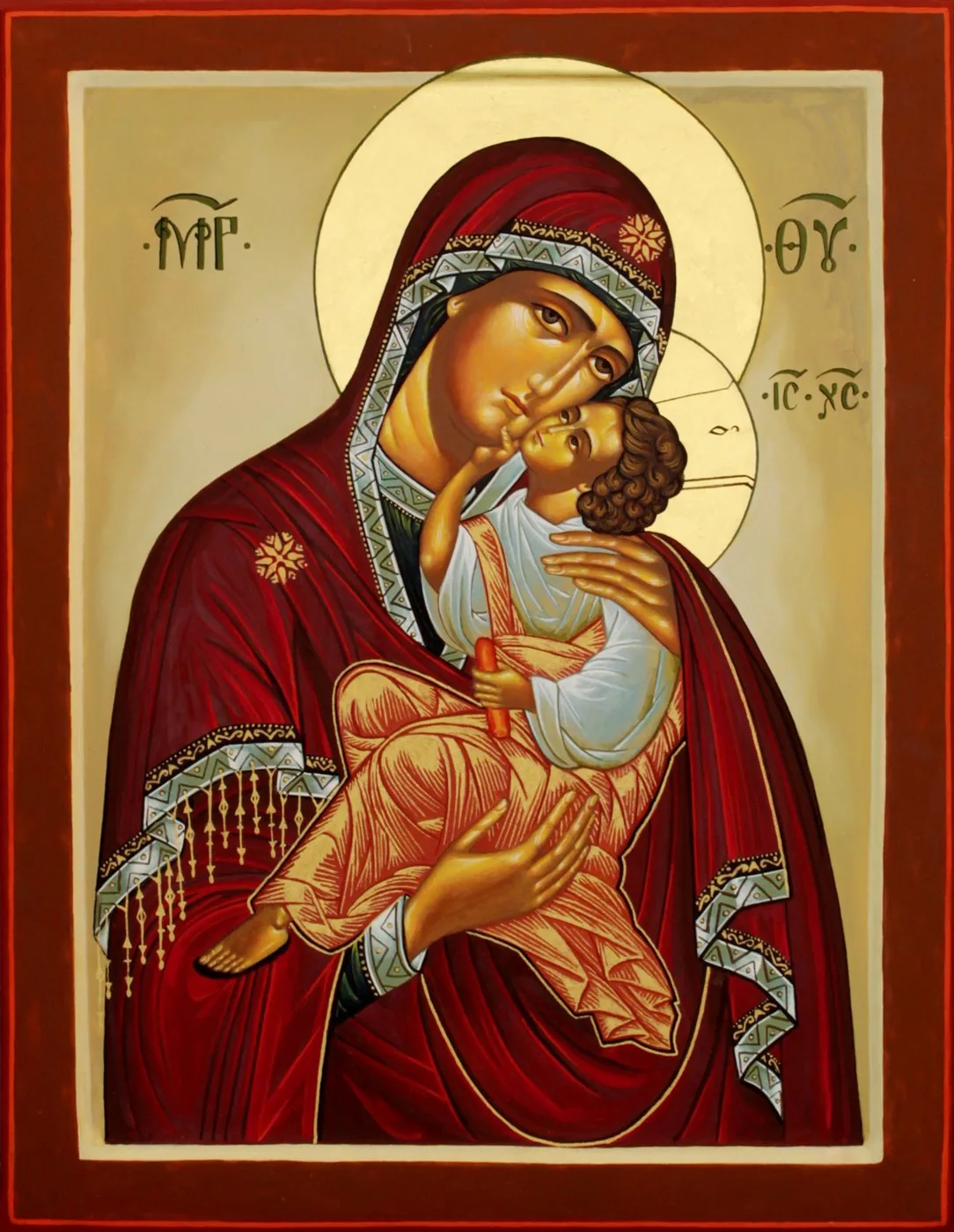
- The Mother of God of Tenderness: Mary holding her Son cheek to cheek, a symbol of protective love.
- Christ Pantocrator: for those who wish to place their home under Christ's gaze.
- The patron saints of the couple, or of the town where they marry.
An icon is also a precious gift for a baptism, a wedding anniversary or a first home.
A group gift that truly matters
A gold icon is the ideal gift to give together: friends, colleagues and relatives can join forces and give the couple something none of them would ever give alone. Instead of many objects destined for a drawer, a single work that stays in the family.
Its value is twofold. There is a real material value: the gold, the wood, the pigments, an artist's hours of work, the certificate of authenticity. And there is a spiritual value that cannot be measured: an icon accompanies the couple's prayer, witnesses the celebrations and the hard days, and passes to children and grandchildren.
For lovers of sacred art in Italy's great cities
Anyone who has walked beneath the golden domes of St Mark's, or stood before the gold-ground panels of the Uffizi, can tell at a glance the difference between a devotional picture and a work of sacred art. A hand-written icon speaks most to these people. Here are the places in Italy where that sensibility is at home.
- Venice: the golden mosaics of St Mark's Basilica, the Pala d'Oro and the Museum of Icons of the Hellenic Institute, beside San Giorgio dei Greci. Between the fifteenth and seventeenth centuries the madonneri, icon painters between Crete and the lagoon, worked here.
- Ravenna: the Byzantine mosaics of San Vitale and Sant'Apollinare, a World Heritage Site.
- Florence: the gold grounds of Cimabue and Giotto in the Uffizi, the Baptistery mosaics, and the Council of 1439 that brought the Latin and Greek Churches together in Florence.
- Siena: Duccio's Maestà and the great Sienese school of gold-ground painting.
- Rome: the icon of the Salus Populi Romani in Santa Maria Maggiore, the early Christian mosaics and, in the Castelli Romani, the Abbey of Grottaferrata, where monks have prayed in the Byzantine rite since 1004.
- Padua and Assisi: Giotto in the Scrovegni Chapel and the Basilica of St Francis, the Basilica of St Anthony.
- Milan: the Cathedral, the Brera Gallery, the Diocesan Museum.
- Lake Como: historic villas with their private chapels, Como Cathedral, the Sacro Monte of Ossuccio.
- Trento and Trentino: the city of the Council that in 1563 reaffirmed the value of sacred images, the Cathedral of San Vigilio, the Tridentine Diocesan Museum and the parish churches of the valleys.
- Bari: the Basilica of St Nicholas, a destination for Catholic and Orthodox pilgrims.
- Sicily and Calabria: the mosaics of Monreale, Cefalù and the Martorana in Palermo, the Byzantine-rite communities of Piana degli Albanesi and Lungro, the Cattolica of Stilo and the Purple Codex of Rossano.
For a couple marrying in Venice, Florence or on Lake Como, a gold icon is also a way to take the spirit of those places home. And for collectors in Milan, Rome, London, New York or Zurich who know the value of sacred art, it is a gift that will be recognised for what it is.
Concetta Basile's iconography studio, between Messina and Taormina
Concetta Basile's studio creates handmade Byzantine sacred icons in the traditional way, with 23¾ carat gold and natural pigments, on panels of fine woods. It creates icons in both the Catholic and Orthodox traditions, including commissions, and every work comes with a certificate of authenticity. The studio ships throughout Italy and abroad, and also works on commission with interior designers and architects furnishing luxury villas and residences. The studio is in Sicily, between Messina and Taormina, in a land where Byzantine art left the golden mosaics of Monreale and Cefalù.
To see the works and ask about an icon for your wedding, visit www.concettabasile.com.
And if you are marrying in Sicily, read also how to choose church wedding musicians in Taormina and in Messina.
What this story teaches
We live surrounded by objects that last a season. A hand-written icon goes the opposite way: it takes time to be born, and it outlasts far more.
Giving one to a couple means telling them: your love deserves something that does not pass. And placing it, every day, under a light that does not go out.
Frequently Asked Questions
How can you tell a hand-painted sacred icon from a print?
In a hand-painted icon you can see the colour glazes and brush marks, real gold changes its light as the panel moves, and the surface has the thickness of the gesso preparation. A print, under a magnifying glass, shows printing dots. An authentic work also comes with the artist's certificate.
Which icon should you give as a wedding gift?
The most fitting subjects are the Wedding at Cana, Jesus's first miracle at a wedding feast, the Holy Family and the Mother of God of Tenderness. The couple's patron saints are another option.
Why is gold used in icons?
In the Byzantine tradition gold represents the divine light in which the saints live. It is not a decorative background: it is the sign of God's presence.
Can an icon be a group wedding gift?
Yes. Friends, colleagues or relatives can join together to give the couple a hand-painted gold icon: one important gift instead of many objects, meant to stay in the family.
Where should you hang an icon at home?
In the Eastern tradition icons are placed in the most beautiful corner of the home, in a place of prayer. Avoid direct sunlight, humidity and heat sources.
Where is Concetta Basile's iconography studio?
Concetta Basile's studio is in Sicily, between Messina and Taormina. Works and contacts are at www.concettabasile.com.
Where can you see icons and gold-ground art in Italy?
Key places include the Museum of Icons of the Hellenic Institute and St Mark's Basilica in Venice, the Byzantine mosaics of Ravenna, the gold grounds of the Uffizi in Florence and the Sienese school in Siena, Santa Maria Maggiore in Rome, the Abbey of Grottaferrata, and the mosaics of Monreale and Cefalù in Sicily.
Can you order an icon if you live in Milan, Florence, Rome, Trento or abroad?
Yes. Concetta Basile's studio works on commission and ships its works throughout Italy and abroad. Contact it at www.concettabasile.com.